Tuesday, February 21, 2012

Farmers sow seeds of growth for Mumbai’s home gardens

HT Correspondent, Hindustan Times  Mumbai, February 21, 2012

Ghani Khan, 35, reluctantly took the reins of his 20-acre ancestral farm at Kirugavulu, in Karnataka’s Mandya district, in 1992. His father had suffered a paralytic attack and as the eldest son, he had to drop his academic aspirations and look after the farms.

Today, Khan boasts of having collected up to 200 varieties of rice, many of which have medicinal properties.
He also hosts tours of his farm that produces rice, mangoes, guava, sugarcane, banana and coconut.
Khan is one among several farmers from five states participating at the Seed Festival at Janata Kendra, Tulsiwadi, to showcase their indigenous seed varieties. The seed festival has been organised to celebrate the rich diversity of crops and spread awareness about hundreds of local seed varieties that do not usually figure in urban diets.
Khan is associated with Sahaja Samrudha, a farmer’s collective that has built a network of organic farmers in Karnataka. Like Khan, there were farmers from Bastar in Chattisgarh, Satna in Madhya Pradesh, Nayagarh in Odisha and Auroville in Puducherry at the seed festival.
Some of them were selling their local brinjal, cucumber and gourd seeds for Rs. 10 per packet while some offered an entire range of seeds for full-fledged home gardening.
“The produce from my farm is 100% chemical free. Organic farming has not only increased my farm yield but is also the prime reason I have managed to protect old seed varieties. It is our responsibility to preserve our traditional ways of farming and be generous in sharing local seed varieties, that is the way to practice and promote agro- bio diversity,” said Khan.
“Many people I know want to eat organic farm produce but don’t know anything about it. I am well connected in the grocer community and came to explore the potential to market organic farm produce,” said Kishore Salia, a wholesale garment trader from Dadar.
The seed festival ends on Tuesday with the screening of ‘Raghuvanshi – The Seed Man,’ a film on a Varanasi farmer.

Source: http://www.hindustantimes.com/India-news/Mumbai/Farmers-sow-seeds-of-growth-for-Mumbai-s-home-ga/Article1-814534.aspx

Thursday, December 29, 2011

Indian farmer get appreciation for innovation with aromatic rice

29 Dec 2011
GANGTOK (Commodity Online): India's Directorate of Rice Research has appreciated Kailash Rana Manger, a progressive farmer from Sikkim, for innovations in rice cultivation and he was called as the rice innovator of Sikkim during the ‘Innovative Rice Farmers Meet 2011’ held in August at Hyderabad.
Manger had been appreciated for his innovative replacement of ‘Kalo Nuniya Dhaan’ in place of local scented variety for a high yield, fragrance and fixed black coloured grants.
‘Kalo Nuniya Dhaan’ is known as the “prince of rice” and is considered the best tiny aromatic rice in the world, a substitute for basmati rice.
With 20 years of experience in farming, Mangar gave his presentation on ‘Kalo Nuniya Dhaan’ during the meet at Hyderabad.
Acccording to Manger, a scented rice cultivar was first brought from a progressive farmer of Maal Bazaar, Jalpaiguri and is capable replacing of local rice variety Dudha and Tulsi.
He does farming in 3 acres land on lease basis of Rs. 20,000 per annum and had introduced this new variety of rice last year by obtaining 3 kgs of seed from a progressive farmer of Jalpaiguri and sowed the seeds using the System of Rice Intensification technique with guidance from Krishi Vigyan Kendra (KVK), Saramsa under Indian Council of Agriculture Research (ICAR).
The production was 4 quintals of rice which surprised him as it was four times more as compared to the other local varieties.
Mangar sold the produce at Rs. 8000 per quintal. He used to sale local variety at Rs. 2200-2500 per quintal. This year, Mangar is expecting a harvest of 16 quintals of rice from 6 kgs of seed.
He explained that the ‘Kalo Nuniya Dhaan’ plant has 25-28 tillers per hill with panicles of 20-20 cm and 156 grains per panicle. Not only the rice, even the straw of this variety is highly demanded as it has good nutritious value and is used as fodder for cattle.
Mangar pointed out that many farmers have given up agriculture due to increasing labour costs. Farmers who have small holdings can go for this variety of rice which is much profitable.
This package of practices is standardized by the farmers and the cultivar is being adopted by farmers of different villages of the East District. The demand of Kalo Nuniya Rice is very high in other States as the farmers from Mumbai, Delhi, and Hyderabad already demanded him for seeds, he revealed.
Mangar’s hard work is not only limited to agriculture as he also does horticulture cultivating cabbage, cauliflower, Broccoli, Baby Corn and other vegetables. He has been able to sellproduce worth Rs. 11,000. He is earning Rs. 1.5 lakhs per annum through farming.
The farmer is also a beneficiary of Department of Biotechnology Project of the KVK.
Source : http://www.commodityonline.com/news/indian-farmer-get-appreciation-for-innovation-with-aromatic-rice-44757-3-44758.html

Monday, December 19, 2011

NEWs: From farmer to retailer, he sows seeds of change in Bangalore market

December 19, 2011

INDIAN EXPRESS
http://www.indianexpress.com/news/from-farmer-to-retailer-he-sows-seeds-of-change-in-bangalore-market/889481/

Forty-year-old K H Krishnamurthy has been a farmer all his life. But one day, eight months ago, the Class X dropout from Kolathur village in Hoskote taluk outside Bangalore city decided he could do better.

“For 11 years, I had been supplying vegetables to supermarkets in Bangalore like Reliance, Food World, Nilgiri’s and Namdhari. I thought I should open a supermarket of my own, where I could sell produce from my farm and that of other farmers known to me,” he says.
His dream came true two months ago, when A1 Fresh World, Bangalore’s first farmer-owned supermarket, opened in Kadugodi, near upscale Whitefield. Hundreds of shoppers flocked to the store — located strategically in the midst of several high-rise apartment buildings — on its opening day, raking up Rs 2.5 lakh in sales. The farm-fresh vegetables and competitively priced groceries were an instant hit and the store began to draw shoppers from several kilometres away.
“I took a bank loan of Rs 18 lakh and invested in this store. It was a big gamble and I am glad it has paid off,” says Krishnamurthy.
A single-storey building, the 4,000-sq ft store stocks everything from groceries to steel utensils to baby food. Fifteen employees manage stocks, man the three billing counters and sort and pack groceries in the small warehouse attached to the store. Five others pick up fruits and vegetables from farms in Hoskote and deliver them, morning and evening, to the store, 15-20 km away. Groceries and exotic fruits are sourced from wholesale markets in Bangalore.
“Every day, we sell 1.5 tonnes of vegetables and fruits. On an average, we get 452 customers a day and make Rs 1 lakh-1.5 lakh in sales, depending on the day of the week,” Krishnamurthy says. His monthly expenses add up to Rs 2.5 lakh, which, he says, is half of what a corporate-owned supermarket spends.
With sales looking up, Krishnamurthy hopes to break even soon and open five more stores in the city in a year. “Now I get 50 per cent of the produce from my farm. But I want to buy more from other farmers. If I can buy 12-13 tonnes of vegetables and fruits from them everyday, I will get a good price,” he says.
He has a habit of thinking ahead. Six months ago, when he zeroed in on this plot of land that he has leased for 14 years at Rs 75,000 per month, he decided to build his supermarket without any help from city-based engineers. He left parking space all around and is now constructing a small room to house an HDFC Bank ATM, which will fetch him Rs 13,000 a month.
“I have to count every penny. There are frequent power cuts here, but I cannot yet afford a big generator,” Krishnamurthy says. However, he isn’t the least bit worried by the possibility of FDI in retail. “I am not a fan of corporates but if it means farmers will have a bigger market and get better prices, then why not?” he says.
Krishnamurthy says customer feedback has helped immensely. He has realised, for instance, that he must stock rajma, dhokla pots and Gujarati mamra to cater to the north Indian crowd. His learning curve has been steep, he says: in two months, he has picked up some Hindi and English, deduced urban preferences for things like baby potatoes which are of little value back in his village, and figured out that the home delivery model isn’t efficient. When customers wanted to buy fish and chicken, he promptly contracted out a small cabin in one corner of the store to a local vendor.
Krishnamurthy’s sons, Adarsh, 16, and Sudarshan, 14, help out with the weekend rush. “Earlier, when we got up early, we would go to the field to help with farm work, but now, on holidays, we come here to get a hang of the business,” says Adarsh, who takes a bus from Hoskote to Bangalore to go to school every day.
The family has about 20 acres of land back home, of which eight acres are devoted to a vegetable garden where every day is harvest day. Adarsh wants to study management and help his father expand his business. Sudarshan enjoys working the billing systems for now.

The store opens as early as 7.30 am and shuts at 9.30 pm. The extra hours fetch Rs 10,000-15,000 more every day, Krishnamurthy says. “My father asks me why I have to work so hard from 5 am till midnight. Life isn’t easy for a farmer. I want to do more, for myself, and for other farmers,” he says. 

Monday, December 5, 2011

Eats shoots and leaves

, TNN | Dec 4, 2011, 07.30AM IST

The sci-fi writer Orson Scott Card said that unemployment was capitalism's way of getting people to plant gardens. (By that measure , the UK should be blooming ). In Mumbai, it's not unemployment that's driving some to the soil, but inflation, a rising concern about the health of their food, interest in organic food culture, and, not least, the desire to de-tox and destress naturally. 

Across the field, urban gardeners have been reporting about the city's growing interest in pots and plants. Guncha Khare, who runs Bombay Hub, the 'laboratory of social change' , says their monthly urban gardening workshops have been packing in a full house every time. "Every batch is attended by about 15 to 20 people, and it's a new audience every session," she says. The workshops are presently conducted by Adrienne Thadani, who runs Fresh and Local, an organisation that consults on organic gardening. "We try to propagate the benefits of organic farming; show people how easy and inexpensive it is; teach them how to work around constraints of space, and guide them towards timeand resource-saving techniques of gardening," she says. "We also teach them how to make their own compost from recycled kitchen waste." 

The clincher in the organic argument lies in the sampling of the fruit of labour. The harvest of veggies and herbs, like tomatoes, okra, basil and bay leaves from the hub's terrace garden is distributed to participants of the workshop so they can taste the difference between organic and chemical produce. Associated initiatives like Hari Bhari Tokri (the community farming experiment that supplies organic produce to subscribers), and Farmers' Markets have also done service to indie food culture and changed tastes. 

Urban gardeners on the crusade to make planters of the public have discovered the blog as soapbox. Mani Pattabiraman , who blogs under the alias Geekgardener, says he has 600 members on his forum and receives about 30 to 40 emails a day from people inquiring after his posts on hydroponic techniques , potting options and so on. "I usually advise beginners to start with one plant, say spinach or coriander, and tend to it until they're self-sufficient in its yield," says the Bangalorebased software engineer, whose kitchen sources from his terrace garden. "I haven't bought tomatoes in three and a half years," he claims. The engineer-gardener has even sold his surplus yield of beefsteak tomatoes and 18-inch long seedless cucumbers to the local supermarket and occasionally sells his produce in his office. 

Unlike Mumbai, which is a fledgling in the field, Bangalore has a relatively large group of terrace potters who come together for seed swaps and plant exchanges. But Mumbai is catching up. Urban Gardener Sunita Mohan, who writes the blog Urban Gardener , says she has been getting many inquiries from people who are interested in growing their own food. "Mumbaiites are foodies at heart," she says, referring to their interest in planting edible gardens as a natural progression of their interest in eating. "They also want to guarantee that their food is not toxic; they want to know that the sprouts in their salad or the spinach in their soup comes from a safe space, where the water and nutrients can be vouched for." 

Promoters are also pitching the exercise as a natural rejuvenator. The feel of earth and thrill of creation is a guaranteed restorative, they say. And for those who don't want to potter around in private or keep a lonely garden, groups like Urban Leaves invite them to the community farm. The farm, on the grounds of Maharashtra Nature Park, has been drawing a steady stream of volunteers who gather every Sunday morning to sow and reap and make a picnic of planting. 

"We're in the second year of the farm; it usually takes about three years to build a sustainable garden and get a good yield," says Preeti Patil, founder member of the group, who is also noted for turning one of the canteen terraces of Bombay Port Trust into a horn of plenty. Keen to take urban farms far, the group has even set up a small patch at Bai Avabai Petit Girls High School, Bandra. "It will hopefully be tended by the boarders of the school, who can then enjoy its produce," says Patil. 

Next week the propaganda for urban farming will be cranked up a degree when Urban Leaves hosts the second edition of the National Seminar on Organic Urban Gardening in Mumbai. The event will gather several experts to the table to talk about the principles of permaculture, medicinal gardening, plant-based diets, and explain the science of Nateuco Farming. 

Clea Chandmal, a specialist in molecular genetics and plant breeding, says she will be talking about terrace gardening and city farming the Permaculture way. "Permaculture is an integrated systems approach to designing a sustainable human supporting environment ," she explains. "It integrates, water, energy, food and house design." Chandmal will lecture on how one can set up a Permaculture terrace/ city farm to grow at least some of one's own food. "In addition to food becoming very expensive and ridden with cancercausing pesticides, our earth is also running low on oil. When Cuba had no oil in the '90s, fueldependent agriculture became impossible. Cubans got together and grew their own food on terraces and in parks. In India, many home owners are growing their own vegetables; Goa, Bangalore and Delhi have many examples. There are even competitions for kitchen gardening in these cities." 

In time, kitchen garden culture will prevail here too. After all, the seed has only just been sowed.

Source: http://timesofindia.indiatimes.com/city/mumbai/Eats-shoots-and-leaves/articleshow/10977051.cms?referral=PM

Sunday, June 19, 2011

What countries have banned GMO crops

These days in Southern Minnesota, it's hard to find any fields that aren't planted with genetically modified corn or soybeans. While GMO crops are quickly taking over the landscape in the United States and Canada, not all countries have embraced these questionable crops.
Here's a list of countries (and U.S. counties) that have banned genetically modified crops in one way or another.
In the United States: Only the California counties of Mendocino, Trinity and Marin have successfully banned GM crops. Voters in other Calilfornia counties have tried to pass similar measures but failed.
In Australia: Several Australian states had bans on GM crops but most of them have since lifted them. Only South Australia still has a ban on GM crops, though Tasmania has a moratorium on them until November of 2014.
In Japan: The Japanese people are staunchly opposed to genetically modified crops and no GM seeds are planted in the country. However, large quantities of canola are imported from Canada (which is one of the world's largest producers of GM canola) and there is now GM canola growing wild around Japanese ports and roads to major food oil companies. Genetically modified canola such as Monsanto's Roundup Ready canola have been found growing around 5 of the 6 ports that were tested for GM contamination.
In New Zealand: No GM foods are grown in the country.
In Germany: There is a ban on the cultivation or sale of GMO maize.
In Ireland: All GM crops were banned for cultivation in 2009, and there is a voluntary labeling system for foods containing GM foods to be identified as such.
In Austria, Hungary, Greece, Bulgaria and Luxembourg: There are bans on the cultivation and sale of GMOs.
In France: Monsanto's MON810 GM corn had been approved but its cultivation was forbidden in 2008. There is widespread public mistrust of GMOsthat has been successful in keeping GM crops out of the country.
In Madeira: This small autonomous Portugese island requested a country-wide ban on genetically modified crops last year and was permitted to do so by the EU.
In Switzerland: The country banned all GM crops, animals, and plants on its fields and farms in a public referendum in 2005, but the initial ban was for only five years. The ban has since been extended through 2013.
In India: The government placed a last-minute ban on GM eggplant just before it was scheduled to begin being planted in 2010. However, farmers were widely encouraged to plant Monsanto's GM cotton and it has led to devastating results. The UK's Daily Mail reports that an estimated 125,000 farmers have committed suicide because of crop failure and massive debt since planting GM seeds.
In Thailand: The country has zigzagged in its support and opposition of GM crops. The country had widespread trials of GM papayas from Hawaii but reversed its plans when the seeds got wild and began contaminating nearby crops. Several countries such as Japan moved to restrict the importation of Thailand's papayas as a result, not wanting to import any GM foods. Thailand is currently trying to embrace both sides -- producing organic foods for some countries at a high price while moving towards embracing more and more GM crops. The country has also tried declaring some areas GMO-free zones in order to encourage other countries to trust their foods.
What countries have embraced GM crops?
  • The U.S. now grows mostly GM varieties of corn, canola and soy. Hawaii now grows GM papayas. Approvals have also been given for GM alfalfa, zucchinis, beet sugar and tomato varieties, though not all are currently being grown. A recent attempt to approve GM salmon was defeated.
  • China is one of the largest producers of GM crops.
  • Germany, Sweden and the Czech Republic are approved for growing GM potatoes.
  • Finland's government and population is receptive to GM foods. None are currently grown in the country, however, because no approved GM crops are suitable for the country's growing conditions.
  • The Zambian government has launched a campaign to get the public to support GM technology.
  • Canada has widespread GM crop usage. Nearly all Canadian canola is GM, as is a large portion of the country's soy and corn. Prince Edward Island tried to pass a ban on GMO cultivation but failed, and GM crops in the region are currently increasing.
  • Spain currently grows GMO maize (about 20% of the country's maize is GM).
  • The Czech Republic, Slovakia, Portugal, Romania and Poland all grow some GMO maize.
  • The Phillipines grow GM crops.
  • The European Union (EU) has approved the cultivation of many GM crops (including potatoes and maize) but individual countries are able to opt out from growing them. However, most EU countries are not permitted to reject the sale of GM foods.
  • South Africa is growing an increasing number of GM crops.
  • Britain officially supports GM crops and has trials of GMOs like potatoes planted. However, there is widespread public distrust of the crops and Prince Charles has been a vocal opponent of GMOs.
  • South America has widespread planting of GM crops.
  • As mentioned above, Thailand is alternately embracing and rejecting GM crops.
  • India also has widespread GM cotton use. Also mentioned above, the widespread planting of Monsanto's GM cotton has led to tragedy throughout India. The Indian government even banned conventional seeds from many government seed banks in an attempt to please Monsanto (in return, the country was given International Monetary Fund loans to help its economy) and slow the nation's poverty rates. An estimated 1,000 farmers commit suicide each month in the country as a result of the crop failure and debt caused by planting the GM seeds. Farmers were convinced to spend what was often 1,000 times the cost of conventional seed on the "magic seeds" after listening to Monsanto's promises of increased yields and resistence to pests. Despite the promises, the crops were often destroyed by bollworms. In addition, the farmers weren't warned that the crops would require twice as much water as conventional cotton, leading to many crops drying up and dying. The "terminator" seeds also must be purchased again every year. For farmers used to saving seed from year to year, this was often a final financial blow that led to insurmountable debt.
The variation in each country's laws and views regarding GMOs has led to complications when it comes to exporting foods. For example, Thailand has been working to reassure other countries about the safety of its food but recently had its canned tuna rejected by Greece and the Netherlands after testing showed GM ingredients. The tuna was packed in soybean oil imported by the United States, where most soy is genetically modified.
Some Americans are now looking for foods like canola oil and soy products that are not grown in the United States, thinking that it's a way to avoid GM foods. This is obviously not a good idea. It's important not to assume that just because a food was not produced in the United States, it's not genetically modified.
Until consumers have the right to labeling informing us of which foods contain GM ingredients, it's important to be aware of which countries are now growing GM foods and which foods are produced.

Source: http://www.examiner.com/article/what-countries-have-banned-gmo-crops

Saturday, June 11, 2011

Monsanto officials beaten up by Cotton farmers as Bt.cotton seed failed: Bogus Bt.cotton seed creates havoc in vidarbha

 Nagpur- July 11, 2011
American cotton seed MNC giant Monsanto of having international monopoly of notorious killer BT. cotton seed has never even dreamed in 2005 when he was first commercial cultivation permission of it’s controversial Bt.cotton seed that it sale will jump from 1million hector to record 15 million hector in India that too more than 5 million hector in agrarian crisis hit Maharashtra itself that has crossed the turn over of Rs.15,000 crore as farmers are buying 11 packets of 450 gm per hector as per company’s guide for recommended “population method” but the sudden demand and ill-managed Indian sub agents have brought company in big trouble as 50% of the Bt.cotton seed failed to germinate even after it’s second sowing and now cry has been started in other part of India too ,hence Vidarbha Janandolan Samiti farmers advocacy group has approached local state Govt. of Maharashtra to arrange high level probe in to all complaints received from farmers of west vidarbha where more than 10,000 cotton farmers have committed suicide since june 2005 after the introduction killer BT. cotton seed in this region and around Rs.10,000 crore has been pumped by Indian and state Govt .to bailout cotton farmers from the agrarian crisis which is likely to be get more fuel if corrective action are taken immediately ,Kishore Tiwari of Vidarbha Janandolan Samiti informed today.


Monsanto Bt.cotton seed crisis early June when all bt.cotton seed ordered by Maharashtra dealers sold out it to the adjourning Andhra farmers and there was no seed available to cater to local market and Monsanto sub-agents were failed to respond to state Govt. request suddenly Bt.cotton seed were freely available in market in third week of June but source supply has discovered immediately by Yavatmal police when the raided house of Nerendra Indurkar in the very small village Munjala and caught raid handed packing local cotton seed in the pocket of branded Bt.cotton .police have sealed the very advance imported pocket packing machines and thousands of packets of all popular brands BT. cotton seed being sold on the premium but culprit Nerendra Indurkar were allowed to go with out any interrogation but officials of American BT. cotton seed giant in India were called and facts were told but they denied any link with such bogus BT. cotton seed supply racket.
Monsanto officials beaten up by Cotton farmers as Bt.cotton seed failed

When news of arrival Monsanto senior official from Mumbai are in near village munjala cotton farmers of village karanji 140 K.m. from Nagpur has taken him to their field where complete failure of ‘Paras Sudarshan’ BT. cotton seed was shown to him when he failed to admit the lapse he was severely beaten up even local agriculture officer has not came to his rescue as per reports published in regional news papers .daily all regional papers in vidarbha and marathwada region of Maharashtra where more than 4 million hector are in under bt.cotton cultivation are reporting the flood of bogus seed supplied local agents of American cotton seed MNC giant Monsanto giant is being reported but administration has failed to take any action of this serious issue hence Vidarbha Janandolan Samiti has written to Maharashtra Chief Minister Prathiraj Chavan to order judicial enquiry in the supply racket of bogus BT. cotton seed in Maharashtra and arrange to start criminal action against culprit,Tiwari added.
 
SOURCE: Posted by vidarbha times at 11:28 PM

Wednesday, May 11, 2011

PRESS RELEASE: “STOP ALL FIELD TRIALS OF GMOs IMMEDIATELY”: CIVIL SOCIETY"


New Delhi, May 11, 2011: Representatives of five organizations and networks made a strong presentation to the Genetic Engineering Appraisal Committee (GEAC) in its 109th meeting here today demanding that all field trials of GMOs in the country be suspended immediately, given the intrinsic uncontrollable nature of GM technology in addition to the amply-demonstrated incapability of our regulatory system to address issues of biosafety and beyond when it comes to GMOs.
 
Sridhar Radhakrishnan, Convenor, Coalition for a GM-Free India; Dr Ramanjaneyulu, Executive Director of Centre for Sustainable Agriculture; Aruna Rodrigues, SC PIL lead petitioner; Rajesh Krishnan, Manager, Sustainable Agriculture Campaign, Greenpeace India and Kavitha Kuruganti, Convenor, Alliance for Sustainable & Holistic Agriculture (ASHA) made presentations on various issues pertaining to regulation of GMOs in India. They touched upon Bt cotton experience in the country over the past ten years, Bt brinjal risk assessment and issues therewith, open air deliberate releases of GMOs in the form of field trials and concerns therewith and countering industry’s lobbying effort around “delays in product development and commercialization”.
 
GEAC assured the civil society representatives that the issues raised would be discussed in detail in one of the subsequent meetings and that these would be addressed as appropriate.
 
Civil society was prompted to make these presentations to the GEAC in response to some latest developments on the Bt brinjal front and some proposals made by the industry associations in January 2011.
 
In today’s GEAC meeting, groups showcased repeated regulatory failures, incapability, apathy and lack of independence of the regulators as reflected in the case of GM cotton, Bt brinjal and field trials of nearly 14 crops in India and made the following immediate demands:
 
  1. Industry proposals for faster-track approvals of GMOs in our food and farming to be rejected in toto; GEAC not to entertain such proposals since it is not a clearing house for GMOs but has been created to protect our environment, Nature and health.
  2. A comprehensive, participatory review of GM cotton experience in this country to be taken up before proceeding any further with GMO approvals in this country, to glean lessons collectively as a nation and to revamp the regulatory regime.
  3. In the case of Bt brinjal, given the evidence from independent analyses of the problems with various tests that have been done as part of the biosafety dossier, it is time to reject the Bt brinjal dossier; any further assessment on the subject should begin with a need assessment and like mentioned above, should be governed by policy directives in place. Any further assessments should be independent without drawing in the same set of people representing conflicting interests time and again.
  4. Given the fact that field trials are right now riddled with numerous problems which are amply demonstrated by regular violations and malpractices, all field trials to be immediately suspended until all fundamental issues with regard to GMOs and such open air field trials are resolved.
 
For more information, contact:
  1. Sridhar Radhakrishnan: 09995358205
  2. Dr Ramanjaneyulu: 09000699602
  3. Kavitha Kuruganti: 09393001550
  4. Aruna Rodrigues: 09826396033
  5. Rajesh Krishnan: 09845650032

Tuesday, May 10, 2011

Red Rice Mela


Saturday and Sunday, 14th -15th May 2011,10 am- 6 pm
Gandhi Bhavan, Near Shivananda Circle,Bangalore 

Ever heard of Diabetic Rice? Not happy eating polished rice? Here is a solution to all your problems. Consume only traditional land races and keep your family healthy and hearty. So are you interested?
Many in the present generation are not aware of diversity of rice that we have. India had two lakh varieties of rice before Green Revolution. Now only 30,000 varieties are there in our gene banks.
Karnataka is also blessed with a rich culinary heritage that each variety of rice is characterised by its distinct textures, flavours, and tastes. It has a diversity of rice cuisines based on regional specialties and traditional dishes of each rice variety. Besides rice having nutritional and medicinal benefits, the by-products of rice are equally important and beneficial.

Despite its importance as a staple food, interest in its health benefits has only recently attracted attention. Laboratory studies have shown that rice products have anti-cancer properties and the potential to treat other conditions such as diabetes, kidney stones and heart disease. Karibatha is used for curing herpes andKarikalave is a special variety among the medicinal diversity and is usually served to feeding mothers, as it is high in calcium content.Navara, a variety of Kerala, has anti-carcinogenic property, especially against breast cancer.
 ‘Sahaja Samrudha’ in collaboration with NABARD,Save Our Rice campaign and Pristine organics has organised 'Red Rice Mela' on 14-15th May 2011 at Gandhi Bhavan,Bangalore.
‘Red Rice Mela’ is celebration of  rice diversity that is grown with care for your health and environment by our Farmers, who preserve diversity by conserving different varieties of rice. The astounding varieties of Red Rice, from different regions of the state would be exhibited.
 Hope to see you all on 14th May at Gandhi Bhavan,Bangalore!

Contact for more details :
                             Manjunatha,  - 9986453324
                            Shantha Kuamr - 9731275656
                            Seema  -             9900851163
---------------------------------------------------------------------------------------------
Sahaja Samrudha
'Nandana', No-7, 2nd Cross, 7th Main, Sulthanpalya, Bangalore-560 037
Phone: 080-23655302 / 9880862058  www.sahajasamrudha.org

Monday, April 25, 2011

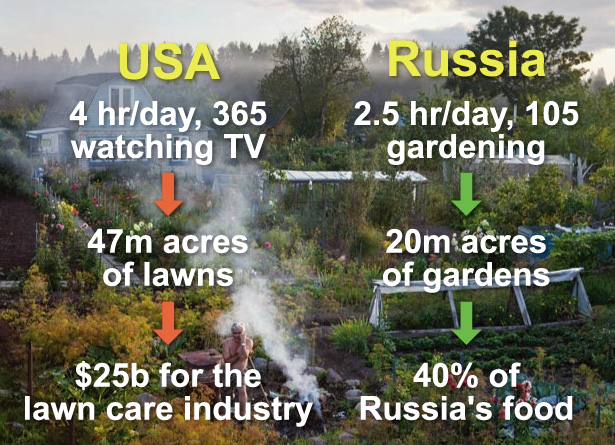
In 2011 the dacha gardens of Russia produced 40% of the nation's food.


While many in the world are completely dependent on large scale agriculture, the Russian people feed themselves. Their agricultural economy is small scale, predominantly organic and in the capable hands of the nation's people. Russians have something built into their DNA that creates the desire to grow their own food. It's a habit that has fed the Russian nation for centuries. It's not just a hobby but a massive contribution to Russia's agriculture.


Sisto-Palkino, Lomonosovsky, Russia


40% of Russia's Food is from Dacha Gardens

In 2011, 51% of Russia's food was grown either by dacha communities (40%), like those pictured left in Sisto-Palkino, or peasant farmers (11%) leaving the rest (49%) of production to the large agricultural enterprises. But when you dig down into the earthy data from the Russian Statistics Service you discover some impressive details. Again in 2011, dacha gardens produced over 80% of the countries fruit and berries, over 66% of the vegetables, almost 80% of the potatoes and nearly 50% of the nations milk, much of it consumed raw.
While many European governments make living on a small-holding very difficult, in Russia the opposite is the case. In the UK one councillor's opinion regarding living on the land was, "Nobody would subject themselves to that way of life. You might as well be in prison"; tell that to a nation of gardeners living off the land.
 
    
During the communist period school children were obliged to visit their local farms to get hands-on experience harvesting food (below left) at a time when about 90% of the nation's food came from dacha gardens. During the same period every child would be expected to play their part in growing the family's food from their small patch of Russia.
While the percentage of food grown by Russia's dacha has fallen since then it is still a massive contribution to the nation's food and forms an important part of their rural heritage. Take a walk through the street's of Russia's cities, like St. Petersburg, and you will find people selling herbs, fruit, berries and vegetables from their dacha gardens. Unlike many cities in Europe and the USA, Russian cities are peppered with small corner shops (below right) selling locally grown food in all shapes, colours and sizes still carrying their native Russian soil.

If you were to visit a typical Russian dacha you're likely to be greeted with a welcoming dish called okroshka (below centre), a refreshing cold soup made from home grown cucumber, radish, spring onion, fresh dill and parsley all swimming in kvas (a home made rye bread drink) with sour cream or kefir.
More insight: Food Gardening in the Vladimir Region of Russia by Sharashkin, University of Missouri–Columbia, MO, USA.


Omsk, Russia


Russian children on a school outing helping with the harvest some time in the 70s.


Making okroshka, a typical dish made to welcome visitors to the dacha.


St. Petersburg, Russia


One of the many small city shops selling home grown food.


Food sovereignty...

Food sovereignty puts the people who produce, distribute and eat food at the centre of decisions about food production and policy rather than corporations and market institutions that have come to dominate the global food system. In Havana, Cuba 90% of the city's fresh produce comes from local urban farms and gardens.
In 2003, the Russian government signed the Private Garden Plot Act into law, entitling citizens to private plots of land for free. These plots range from 0.89 hectares to 2.75 hectares. Industrial agricultural practices tend to be extremely resource intensive and can damage the environment. 70% of global water use goes to farming, and soil is eroded 10 to 40 times faster.

The allotments of central Havana, Cuba


The allotments of central Havana, Cuba


Havana has about 200 urban farms known as organoponicos.


Source: http://www.naturalhomes.org/naturalliving/russian-dacha.htm

Saturday, April 23, 2011

A Problem of Plenty: India's Wheat Surplus - Forbes India

UPFRONT/BRIEFING | Apr 18, 2011 |
India needs to fix its procurement policy and its granaries infrastructure to really make use of its bumper wheat harvest
A Problem of Plenty: India's Wheat Surplus
Image: Amit Gupta/ REUTERS
GROWTH PANGS With Stagnant prices farmers could move away from sowing wheat
I
ndia is growing more wheat than it ever has. That may sound like very good news given the fact that India (along with China) is the largest consumer of wheat, but the fact is, it does not quite know what to do with it.

India doesn’t have policies that will allow the country to use the wheat efficiently. It doesn’t even have enough place to store it. There is also no surety that wheat production will be equally robust in the coming years.

The current state of plenty is just two seasons old. Following the bumper harvest (80.17 million tonnes) of 2010, the country is now looking at another 81.74 million tonnes in a harvest season that has just begun.

“The last couple of years, we have had a good monsoon and hence the production was good. But if we have even one bad monsoon, we will have a shortage,” says Anjani Sinha, MD and CEO of the National Spot Exchange.

These bumper harvests are the outcome of a two-pronged government approach of banning exports, and raising the minimum support price (MSP) as an incentive to bring more land under wheat cultivation.

The gains at the height of the Green Revolution in the 1970s and 80s — riding on the back of high-yield seeds and pesticide use — have been slowing down. Between 2000 and 2010, the land under wheat cultivation grew by just 1.21 percent and there was a drop in yield (compared to the 1980s). Wheat production had fallen to 9.23 million tonnes in 2006-07 and export was banned in October 2007.

However, such an approach doesn’t provide sustained support for wheat farming.

One part of the problem, says Madan Sabnavis, chief economist at CARE Ratings, “lies with the procurement system. Any farmer can sell any amount of wheat to the government and the government has to buy it. The MSP too has been raised to an unreasonable level as it is a political issue.” 
With exports being banned, that means the government ends up being the only buyer from whom farmers get a good price. With domestic prices stagnant for the last six to eight months, and no export options, farmers will soon move away from growing wheat, fears Kunal Shah, a commodity analyst.

Agriculture is a politically sensitive issue and that makes this problem more complex. “The government wants to be seen to be doing something to counter food inflation and therefore takes steps like banning export of wheat and raising the MSP. But, in reality, it is the price of oilseeds, pulses and milk, and not wheat, which is pushing food inflation up,” says Shah.

The other part of the problem is that the government is not equipped to efficiently store and use bumper crops for future consumption, thanks to the pathetic conditions of the warehouses run by the Food Corporation of India (FCI). Enormous volumes of grains rot every year.

The total capacity of government granaries run by the FCI stands at 28.86 million tonnes, a large portion of which is already full with earlier stock. For instance, granaries in Haryana are 78 percent full while those in Punjab are 72 percent full. The two states are among the largest wheat producers in the country. Many other wheat-producing states do not have a good network of granaries.

But there are ways out of this problem of excess.

#1: Encourage Private Players: Shah and Sabnavis both believe that encouraging private players in the procurement and storage process will enable the government to absorb the production from states where FCI infrastructure is inadequate.

In its attempts at increasing storage capacity, last year the FCI started a scheme to invite private participation in building more warehouses. The plan invites private players to build granaries and the FCI guarantees at least 10 years of rent for them. So far, deals to build 10 million tonnes of storage have been signed but these granaries will be completed only by next year.

#2. Limited Procurement: Sabnavis says the government should set a quota for how much wheat it will buy from farmers, and let them export the rest or sell in the domestic market itself.

Sinha, though, is cautious: “We should first see what the total production is at the end of the harvest season and only if we have enough for our buffer stocks should we take a call on whether to allow export of wheat or not.”

This, he says, would be prudent, given the global wheat scenario. “Countries such as Russia and China, which are large producers of wheat, have had a poor harvest and are not exporting their produce. If we start exporting now, and then realise we will be falling short later, we will face a problem where availability and price of wheat in the import market is concerned.”

#3: Build Strategic Reserves: For safety from fluctuations in supply, globally as well as domestically, maintain a constant stock of wheat by creating long-term storage facilities. This will ensure food security. It will also give clarity on the possibilities of exporting wheat when international demand is high.

The global wheat scenario is already raising concerns in many countries. Russia, the world’s third largest exporter, stopped wheat exports after it lost a quarter of its crop last year to its worst drought in 50 years. China, the world’s largest producer, too may lose about two-thirds of its crop after an exceptionally dry winter in its wheat growing region. The impending shortage in the import market has pushed global prices close to their all-time high of 2008.

Countries in West Asia and North Africa are stocking up with orders being placed for several thousand tonnes. This points to fears of an impending crisis of availability and price.

Russia had announced its intent to build strategic wheat reserves along with China and India and even give out 20 million hectares in joint ventures for wheat farming in early 2010. This would protect Russia’s wheat prices and be a counter to the US’ wheat diplomacy (the US is sitting on a stockpile of 30 million tonnes). But that, of course, was in the months following Russia’s 100 million tonne production and before drought brought that figure down to 60-65 million tonnes. 
This article appeared in the Forbes India magazine issue of 22 April, 2011
SOURCE: http://forbesindia.com/article/briefing/a-problem-of-plenty-indias-wheat-surplus/24052/1